


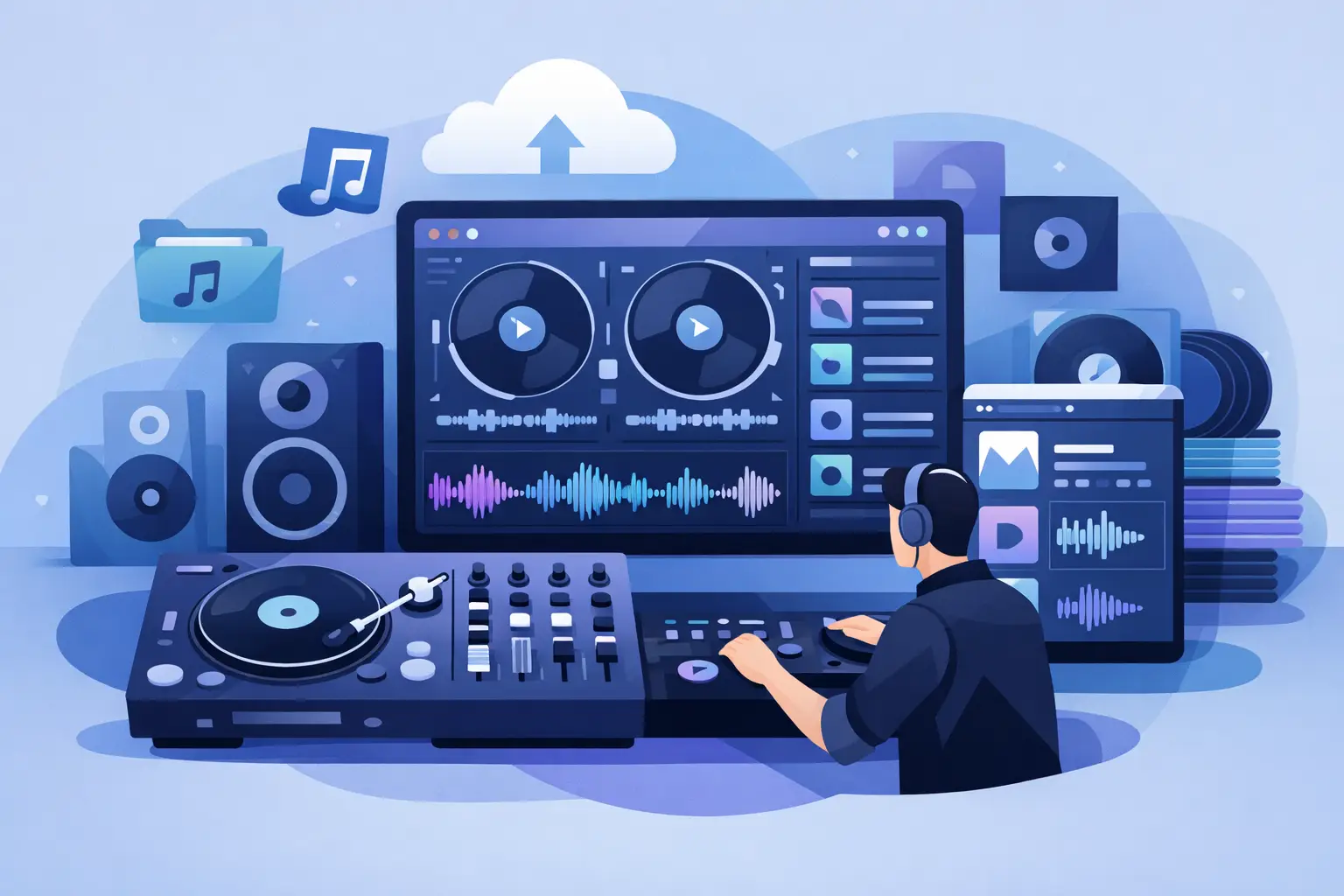
A packed dance floor does not care how messy your hard drive is. But your set absolutely does. If you have ever burned valuable minutes searching for the right intro edit, wondering which version has the clean transition, or loading the wrong remix under pressure, you already know why dj software for music library management matters. Great DJing starts long before you touch the crossfader. It starts with a library built for speed, control, and creative freedom.
The best DJs do not just collect music. They shape a system that lets them react fast, build energy with purpose, and stay in command all night. That is where powerful library management separates casual playback from real performance. When your tracks are tagged properly, analyzed accurately, and organized in ways that match how you actually play, every set gets sharper.
What DJ software for music library management should really do
Basic music apps can sort by artist, title, and genre. That is fine for listening. It is not enough for performance. DJs need software that understands how music is used in a live environment, where timing, mood, compatibility, and crowd response all matter.
Strong dj software for music library management should help you find tracks instantly, even when your memory is working faster than your words. Maybe you remember the vocal phrase, the energy level, the key, or that it worked perfectly after a certain record last weekend. Good software turns those fragments into results. Great software does it without slowing you down.
That means accurate BPM and key detection, smart search, flexible folders, custom tags, dependable metadata handling, and fast database performance even when your collection gets large. It should also support cue points, saved loops, track history, and playlist workflows that fit real gigs, not just bedroom practice.
Fast organization beats perfect organization
A lot of DJs overthink library management because they imagine they need a flawless system before they can play better. They do not. What they need is a system they will actually use.
Start with the categories that matter most in performance. Energy level is one. Clean versus explicit is another if you play public or private events. Intro edits, open format staples, peak-hour weapons, warm-up tracks, and emergency crowd savers all deserve clear labels. These are practical distinctions that help you make quicker decisions under pressure.
Genre still matters, but genre alone can be too broad. A folder labeled House might contain deep, funky, tech, soulful, and festival records that serve completely different moments. The better move is to stack information. Genre plus energy plus vibe plus use case gives you a much stronger system than genre by itself.
This is where advanced DJ software pulls ahead. You are not limited to one rigid filing method. You can sort, filter, search, and build custom views around how you perform. That flexibility matters because a wedding DJ, club DJ, video DJ, and karaoke host all manage libraries differently. One workflow does not fit every gig.
Why search matters more than folders
Folders are familiar, but search is where speed lives. In a live set, you are often thinking in fragments. You might remember that the track is around 124 BPM, in a compatible key, has a female vocal, and works when the room wants something bigger. Digging through folders is slow. Smart search gets you there fast.
The strongest library tools let you search across tags, comments, file names, playlists, and custom fields at once. That turns your library into a performance engine instead of a storage archive. You spend less time hunting and more time mixing.
There is a trade-off here. Search only works well if your metadata is clean. If your library is full of inconsistent naming, missing genres, duplicate files, or random comments, even the best software has less to work with. That is why the smartest DJs clean their libraries as they go, not in one painful marathon.
The hidden advantage of analysis tools
Library management is not just about keeping tracks tidy. It is also about preparing music so your software can help you make better decisions in real time. BPM, key detection, beat grids, waveform overview, gain data, and cue point prep all reduce friction once the room is moving.
Accurate analysis gives you confidence. You can see phrasing more clearly, sort by tempo range, test harmonic options, and move between styles with less guesswork. If your software also supports modern performance features like stems, that opens another layer of organization. Suddenly a single track is not just one record. It is vocals, drums, bass, and instruments that can be repurposed live.
This changes what library management means. You are no longer organizing only songs. You are organizing possibilities.
DJ software for music library management at different skill levels
Beginners often need one thing first - less friction. If importing music, analyzing tracks, building playlists, and finding songs feels complicated, they will spend more time fixing their setup than improving their mixes. Good software should make the first steps easy without boxing people into a stripped-down workflow they outgrow in a month.
For working DJs, the priorities shift. Speed, reliability, and scalability become non-negotiable. A growing library needs to stay responsive. Search needs to stay fast. Playlists for recurring gigs need to be easy to maintain. Hardware integration matters more, because the library is only useful if it connects cleanly to the rest of the booth setup.
For advanced performers, customization becomes a major advantage. They may want tailored browser views, custom fields, color coding, controller mapping tied to library actions, or workflows built around stems, video, or karaoke. That is where professional-grade DJ software earns its place. It adapts to the way you perform instead of forcing you into someone else’s process.
What separates real DJ platforms from generic music managers
A generic media player can store songs. A real DJ platform helps you win the room.
That difference shows up in small moments that matter. Can you pull up a clean version instantly when the crowd changes? Can you see your track history and avoid repeating the same rotation? Can you prep crate variations for different venues without duplicating files? Can you manage video and karaoke content alongside audio if your business requires more than club mixing?
These are not niche needs. They are daily realities for many DJs. The software that handles them well gives you an edge because it reduces hesitation. And hesitation is expensive when you are live.
That is why many DJs move toward platforms built specifically for performance, not just collection management. VirtualDJ stands out here because it combines approachable library tools with serious depth - from smart organization and fast search to advanced live features, broad hardware support, and workflows that scale from first mix to professional gigs.
Choosing the right setup depends on how you play
There is no single best library structure for everyone. A club DJ who lives in long transitions may organize heavily by key and energy arc. A mobile DJ may focus on event segment, clean status, and audience type. A scratch DJ may care more about battle tools, cue prep, and fast sample access. A karaoke host needs reliable catalog handling and quick request lookup.
The right dj software for music library management should support all of those approaches without making any of them feel like a workaround. Flexibility is not just a nice feature. It is what allows software to stay useful as your career evolves.
It also pays to think about future needs now. Maybe today you only mix audio, but later you want to add video. Maybe you start with a small controller, then move to a club setup, DVS rig, or custom mapping workflow. Software that grows with you saves time and protects the work you put into organizing your library.
Build a library that performs under pressure
A great set feels spontaneous, but behind that spontaneity is preparation. The better your music library is organized, the freer you are to react, experiment, and push further. You can take risks because your essentials are always within reach. You can switch direction quickly because your software helps you find the next move, not fight for it.
That is the real value of strong library management. It is not admin work. It is performance prep. It is how you turn thousands of files into a system that supports better transitions, smarter programming, and more confident live decisions.
If your library feels chaotic right now, fix the parts that slow you down most and build from there. Every improvement compounds. Every cleaner tag, smarter playlist, and faster search result gives you more control when the moment counts. And when your software keeps up with your creativity, the whole set opens up.