


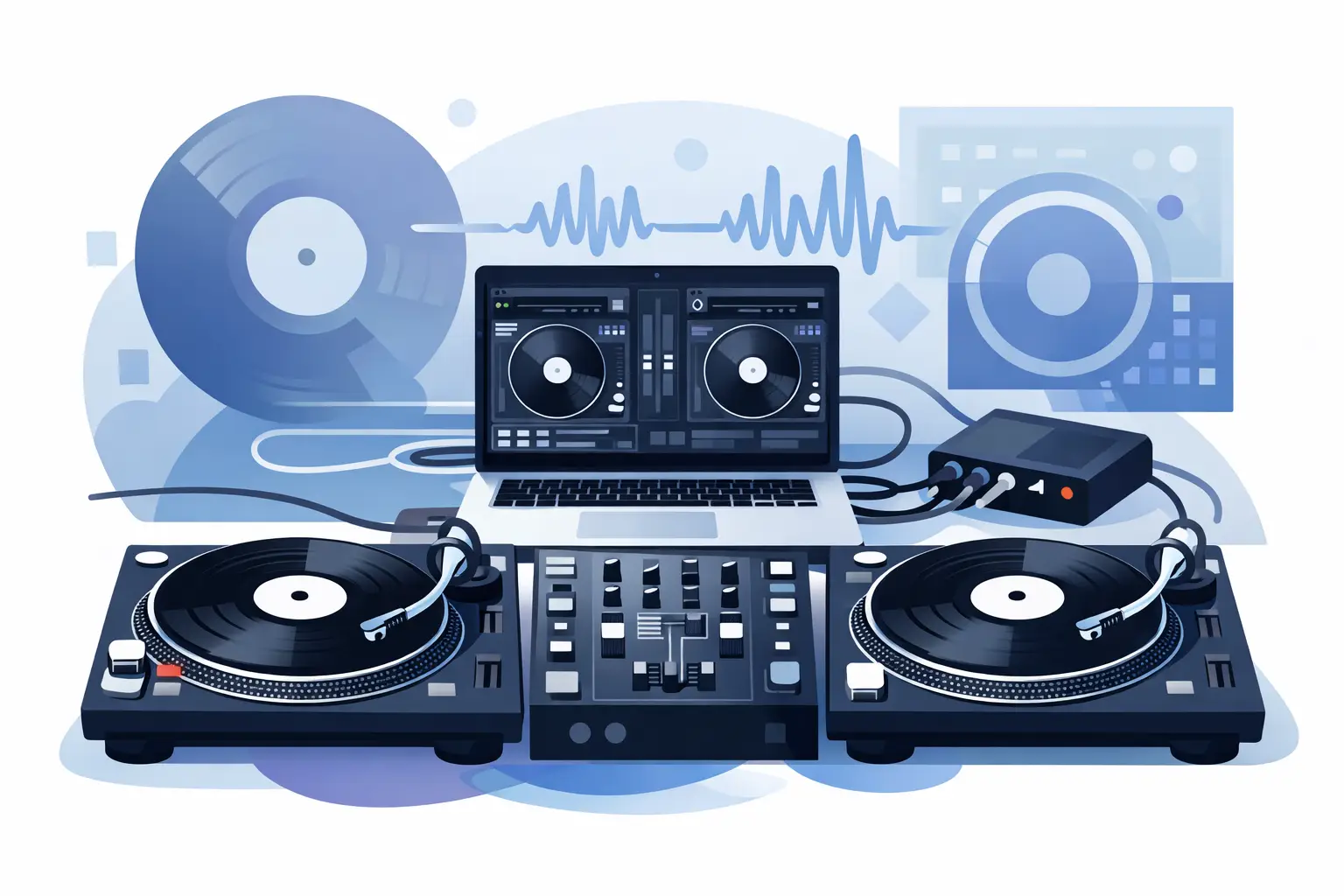
A bad DVS setup tells on you fast. The platter response feels off, cue points land late, and that simple backspin you do without thinking suddenly feels like work. Great dvs software for timecode vinyl should disappear under your hands so the only thing the crowd notices is the mix.
That is the real standard. Not just whether software technically supports timecode, but whether it feels tight, sounds clean, and gives you room to perform at your level. If you are choosing a platform for club sets, scratch practice, open-format gigs, or hybrid controller-plus-turntable workflows, the details matter more than the marketing line.
What DJs actually need from DVS software for timecode vinyl
At its core, DVS lets you control digital files with real turntables or media players using a timecode signal. The concept is simple. The execution is where the good software separates itself from the rest.
First comes tracking accuracy. If the needle movement and on-screen waveform do not stay locked together, every transition feels less confident. Scratching gets sloppy. Tight doubles get harder. Long blends become a trust exercise. Serious DVS software needs reliable timecode interpretation, low latency, and stable performance even when your laptop is doing more than basic playback.
Then there is hardware compatibility. Some DJs build around a specific mixer. Others switch between interfaces, club gear, and home setups. Software that only works well in one narrow environment can become a limitation fast. The best platforms support a wide range of DVS-ready sound cards, mixers, and controllers so your setup can grow with your gigs.
Finally, modern DJs need more than vinyl emulation. You may want stems, video mixing, karaoke support, remix tools, custom mappings, or advanced library management in the same performance environment. That is where choosing DVS software becomes less about one feature and more about your whole workflow.
The difference between usable and performance-ready
A lot of software can claim DVS support. That does not mean it is built for demanding live work.
Performance-ready DVS software for timecode vinyl should give you fast calibration, clear signal quality feedback, and predictable platter behavior. It should recover quickly if the signal gets noisy. It should let you fine-tune latency based on your computer and audio interface. Most of all, it should feel consistent from set to set.
This is especially important if you play outside your bedroom. In clubs and event spaces, conditions change. Turntables may be worn. Needles may not be ideal. Booth vibration might be an issue. Gain staging is not always perfect. Software that handles those real-world variables well gives you a major edge.
There is a trade-off, though. Some platforms are tuned for pure traditionalist workflows and keep the feature set tighter. Others aim to be full creative ecosystems, with DVS as one part of a much bigger toolkit. Neither approach is wrong. It depends on whether your priority is minimalism or maximum performance options.
How the best DVS software for timecode vinyl fits different DJ styles
If you are a scratch DJ, the conversation starts with responsiveness. You want software that tracks fast hand movements cleanly and does not fight your timing. The feel of cuts, chirps, drags, and transforms matters more than flashy extras. In that lane, low-latency response and rock-solid tracking are non-negotiable.
If you are an open-format or club DJ, you may care just as much about set flexibility. You need fast search, dependable hot cues, clean looping, and the ability to pivot across genres without breaking flow. DVS gives you the tactile control of vinyl, but the software still needs to help you move quickly through a modern digital library.
If you are a mobile DJ or event professional, stability and format support can matter even more than turntablist precision. You may need to mix audio, video, and even karaoke from the same platform. In that case, the best DVS environment is not just the one with good vinyl control. It is the one that helps you run the whole show with fewer compromises.
And if you are a hybrid performer, combining turntables with pads, controllers, effects, and live mashup tools, broader software capability becomes a serious advantage. DVS is still the foundation, but it should not box you into an old-school workflow if your style has moved beyond it.
Where advanced software pulls ahead
This is where top-tier platforms start to justify themselves. Great DVS software does not just let you control a track. It gives you more ways to shape that track live.
Real-time stem separation changes the game for turntable DJs who want more than straight mixing. Being able to isolate vocals, drums, or instrumentals while still performing on timecode vinyl opens creative options that traditional DVS users did not have a few years ago. Live mashups become easier. Transitions become more musical. Edits happen in the moment instead of only in prep.
Custom mapping also matters. Not every DJ wants the same workflow, and not every hardware setup behaves the same way. Software that lets you tailor controls, shortcuts, and pad functions gives you a setup that works like your hands work. That matters when speed and instinct are part of your performance.
Library management is another quiet separator. DVS software can have excellent platter response and still frustrate you if finding the next track is clunky. Fast database handling, smart organization, and reliable search save sets all the time. The crowd may never know why your transitions stay sharp, but you will.
Why broad hardware support is a bigger deal than many DJs realize
A DVS setup is never just software. It is software, laptop, audio interface, mixer, turntables or media players, needles, cables, drivers, and venue conditions all interacting at once.
That is why broad hardware support matters so much. If your software works with a wide range of mixers and interfaces, you are less likely to get cornered by a specific booth setup or forced into expensive workarounds. You can practice at home one way, then adapt to a club rig without relearning your system.
This is one area where market leaders have a real advantage. Years of hardware integration, large user bases, and ongoing development usually lead to better compatibility and fewer surprises. For DJs who play professionally, that reliability is not a luxury. It is part of getting paid to perform without drama.
What to watch out for before you commit
Not every DJ needs the same DVS software for timecode vinyl, and buying on hype alone is how people end up switching platforms later.
If you only want a pure two-deck vinyl-control setup and nothing else, a huge feature set may feel unnecessary. More tools are only better if they help your actual workflow. On the other hand, if you want room to expand into stems, video, live remixing, or event work, choosing a narrow platform can feel limiting sooner than you expect.
You should also think about your computer. Advanced features can demand more processing power. If your laptop is older, the smartest choice may be software that lets you scale features up over time rather than forcing everything on at once.
And pay attention to setup speed. DVS should not take forever to calibrate or troubleshoot every time you play. The best platform is the one you trust when the room is filling up and your first mix is thirty seconds away.
A stronger standard for choosing DVS
The best choice is not the one with the longest spec sheet. It is the one that feels closest to real vinyl, stays stable under pressure, and gives you tools that genuinely make your sets better.
For many DJs, that means looking beyond legacy expectations and choosing software built for how performances actually happen now. Tight timecode response still matters. It always will. But so do stems, flexible hardware support, deep customization, strong library tools, and the freedom to move from beginner setup to professional booth without changing your whole approach. That is why platforms like VirtualDJ continue to stand out - they do not force you to choose between accessibility and power.
If you want your turntables to control more than playback, choose DVS software that keeps up with your hands and your ambition. The crowd hears the difference when the technology gets out of the way.